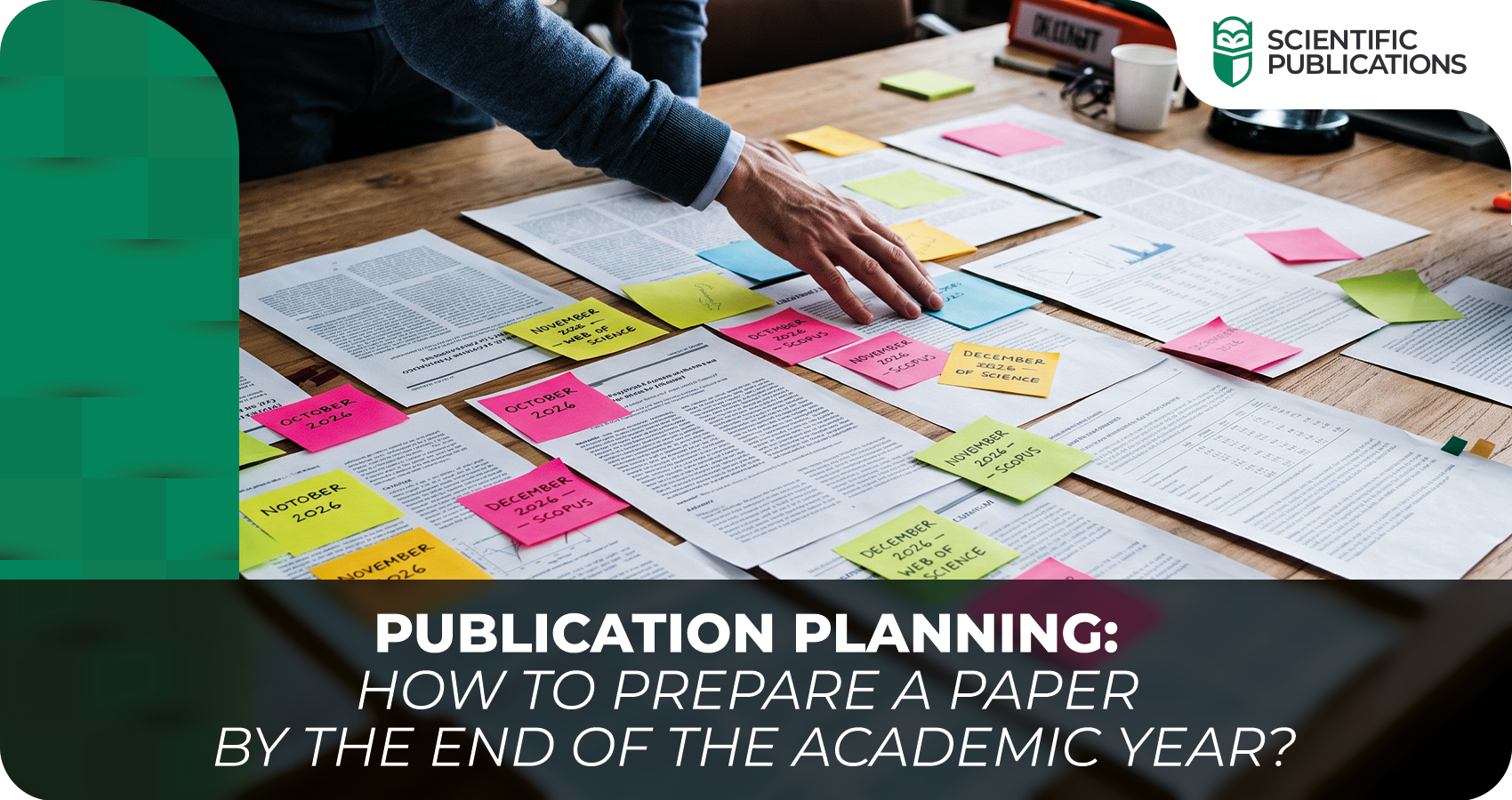
Preparing an article for the end of the academic year requires a carefully planned schedule in advance. The earlier a scientist identifies key dates and the requirements of the chosen journal, the lower the risk of missing the deadline.
Why is planning a publication important by the end of the academic year?
The academic year in higher education and science traditionally ends in May-June. Interim and final assessments, grant reporting and the defence of candidate and doctoral dissertations are often scheduled around this period.
In all these cases, an article needs to be not just prepared, but actually published or at least accepted for publication. If the preparation of a publication is postponed until the last few months, there may not be enough time for full peer review and any necessary revisions.
Review timelines shape the article preparation schedule
The average length of peer review varies depending on the journal and its quartile. In higher-ranked publications, an article may be under review for several months or longer, while in Q3 and Q4 journals the timeline is usually shorter, though it can also stretch out if revisions are required.
Additional time should be allowed for possible rounds of revisions based on reviewers’ comments, technical editing and preparation of the final version for publication. When calculating timelines, it is therefore better to rely on the average and maximum figures given on the journal’s website rather than the minimum ones.
How to calculate the timeline to prepare an article by the end of the academic year?
To avoid running short on time, specialists recommend following this sequence of steps:
- Determine the final date by which the article must be published or accepted for publication.
- Check the average review and publication timeline for the chosen journal.
- Prepare the manuscript according to the journal’s requirements well in advance, rather than right before submission.
- Submit the article with a buffer of one to two months for possible rounds of revision.
- Track the review status regularly and respond promptly to reviewers’ comments.
The quality of manuscript preparation speeds up the review of an article
The speed and outcome of an article’s review depend directly on the quality of its preparation. Before submission, it is worth checking the following points:
- the topic of the article matches the profile of the chosen journal
- the research methodology is described fully and correctly
- the reference list is formatted according to the journal’s requirements
- author details are provided, including an ORCID identifier
- there are no signs of self-plagiarism and sources are cited accurately
Even minor discrepancies with formal requirements can lead to the article being returned for revision and, consequently, to a loss of time.
Is it worth rushing a publication if time is running short?
If little time remains before the required date, it is important not to lower the standards of article preparation and not to consider journals offering suspiciously fast review without objective grounds for it. Such an approach may cast doubt on the legitimacy of the publication during subsequent certification or dissertation defence.
For candidates for academic degrees in Armenia, the requirements for publications needed to defend a candidate or doctoral dissertation are set by the Higher Attestation Committee under the Ministry of Education, Science, Culture and Sport. It is therefore advisable to check the current requirements of the authority and the dissertation council well in advance when planning a publication.
Planning a publication for the end of the academic year helps to avoid last-minute rushing and reduces the risk of delays during peer review. Choosing a journal early, preparing the manuscript in line with all formal requirements and allowing for possible revisions help a scientist meet the deadline without compromising the quality of the work.
Need help with publishing a scientific article? The specialists at Scientific Publications will help you choose a journal with review timelines in mind, check that your article meets the publication’s requirements and support you at every stage of the publication process. To receive a free consultation, fill in the form below and our manager will contact you shortly. Onward to new scientific achievements!