Scientific articles play an important role in the professional activity of scientists. The availability of publications can directly influence the development of an academic career. When writing a paper, several key aspects should be taken into account, in particular the correct formatting of the article. We will discuss the main requirements in our article.
What is a scientific article and what are its main types?
Scientific article – is a form of academic publication that aims to present research results and contribute to the development of a particular field. Usually, in such papers, authors analyse certain aspects of a topic or a scientific problem, summarise previous studies, or propose a new approach to solving a current issue.
Among the main types of scientific articles, the following can be distinguished:
- original scientific article
- review article
- systematic review
- description of clinical cases (Case Report)
- meta-analysis
What should you pay attention to when formatting an article?
1. Topic
When preparing a paper, first of all, it is necessary to approach the choice of the research topic carefully. It should be relevant and correspond to the profile of the journal in which publication is planned. If this requirement is not met, the editorial board of the publication may reject even a high-quality article.
2. Structure
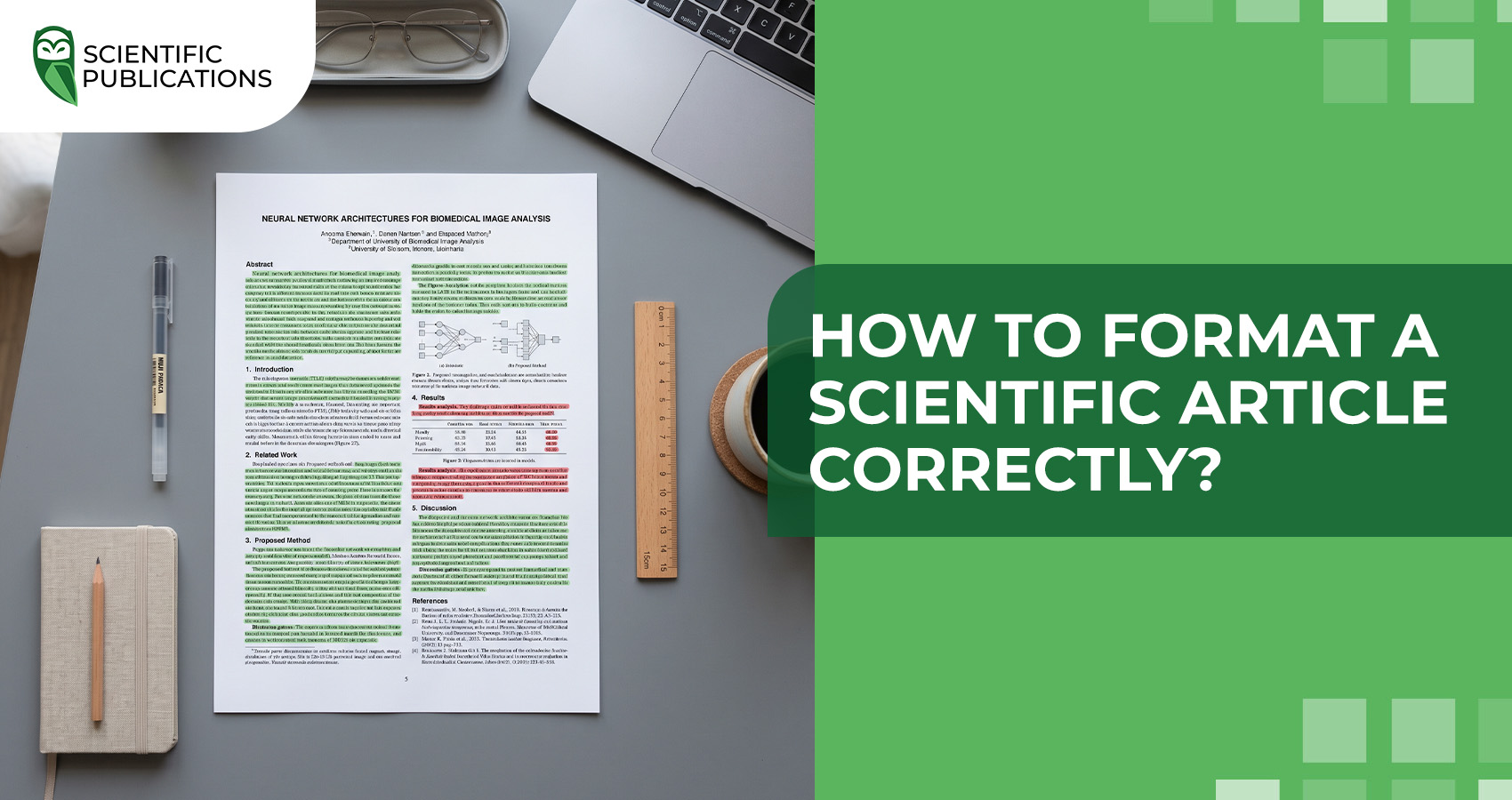
A scientific article should be logically structured and understandable for the editor, reviewers and readers. During the preparation process, it is worth familiarising yourself with the requirements of the specific publication, as they may differ. Usually, the classic international IMRAD structure is used, the abbreviation of which stands for Introduction, Methods, Results, And Discussion.
Based on this, a scientific paper may consist of the following elements:
- Title. It should reflect the main topic and aim of the study and should also not be too long.
- Information about the author. At the beginning of a scientific article, the author’s name and surname, academic degree, position, place of work or study, ORCID and email address are usually indicated. This is necessary for the correct identification of the author, communication with the editorial board, as well as for indexing the article in scientific databases.
- Abstract. In this part, it is necessary to briefly present the main content of the article, the aim and methods of the study, explain the relevance of the topic, and also describe the main results and conclusions. The text must be completely original, without borrowings.
- Introduction. In this section, the problem is usually defined, and the aim and objectives of the paper are formulated. Here, it is also necessary to substantiate the relevance of the topic and briefly analyse previous studies.
- Methods. This section should reveal the course of the research, namely the methods, materials, tools and data sources used by the author. The description should be sufficiently clear and understandable to other researchers.
- Results. Here, it is important not to overload the text with unnecessary information, but to clearly describe the results obtained during the study. These may include data, observations, calculations, tables, graphs, and so on.
- Discussion. At the end of a scientific article, the conducted research is usually summarised, the significance of the main results is substantiated, and prospects for further research are outlined.
3. Length
Usually, journals set certain restrictions regarding the length of the paper, the number of keywords, tables, images and sources. We recommend adhering to the requirements of the editorial board of the specific publication, as the acceptance of the article for publication may depend on this.
4. Presence of errors
After writing and formatting the article, it is important to check the text for errors. A large number of inaccuracies may negatively affect the evaluation of the paper by the journal’s editorial board and reviewers and may lead to the paper being sent for revision or rejected. A well-written text significantly facilitates understanding of the material and demonstrates the author’s professional approach.
5. Compliance with the principles of academic integrity
One of the principles of academic integrity is avoiding plagiarism. Usually, the uniqueness of an article should be at least 85%, so any borrowed information must be accompanied by a correct reference to the source. If these principles are violated, the paper may not be accepted for publication, and the scientist may face serious reputational consequences.
Formatting a scientific article is an important stage of preparing the material, and it should be treated seriously. In order for your paper to be accepted for publication, it is necessary to take into account a number of key aspects: from choosing a relevant topic to complying with the requirements regarding the structure and length of the text. Therefore, we recommend familiarising yourself in advance with the information on publication on the websites of journals or clarifying it in correspondence with the editorial board.
Have you encountered difficulties with editing and formatting a scientific article? Contact the company Scientific Publications. Our specialists will support you in the process of preparing your paper and help you take the main requirements into account. Leave a request on the website, and our manager will contact you shortly. We create successful publications together!