Web of Science is one of the most authoritative scientometrics databases in the world. Publication in journals indexed in this database is evidence of the high quality of the author’s research and his or her competence. However, when choosing a journal for publication, a researcher should understand the specific features of this platform. What is Web of Science? What functions does the platform perform? What are the advantages of publishing in Web of Science for researchers? Let us discuss this in our article today.
What is the Web of Science database?
Web of Science (WoS) is one of the most authoritative abstracting and bibliographic databases, founded by Clarivate. It indexes materials dating back to 1864 and covers thousands of academic journals.
Web of Science content
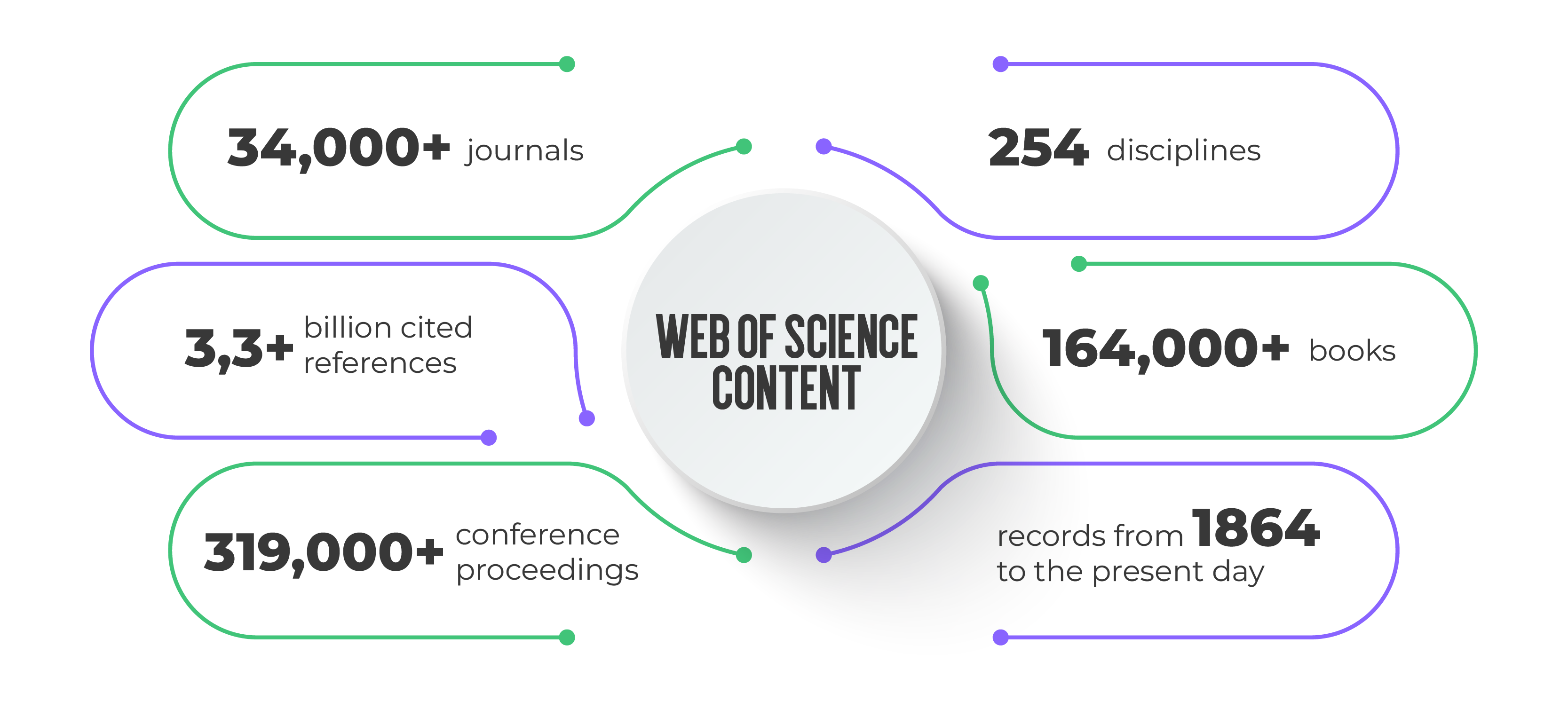
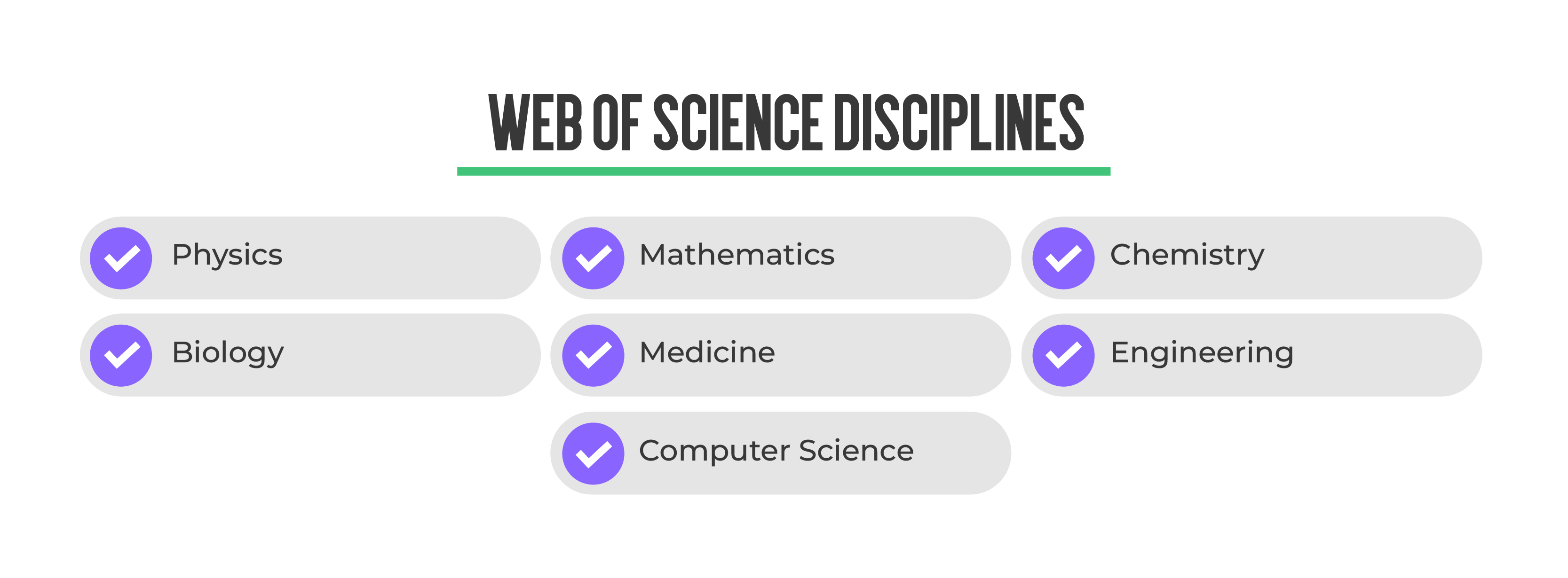
The platform indexes materials across various disciplines; however, priority is given to technical disciplines.
Structure of Web of Science
The foundation of the Web of Science database is the Web of Science Core Collection, which consists of numerous indexes.
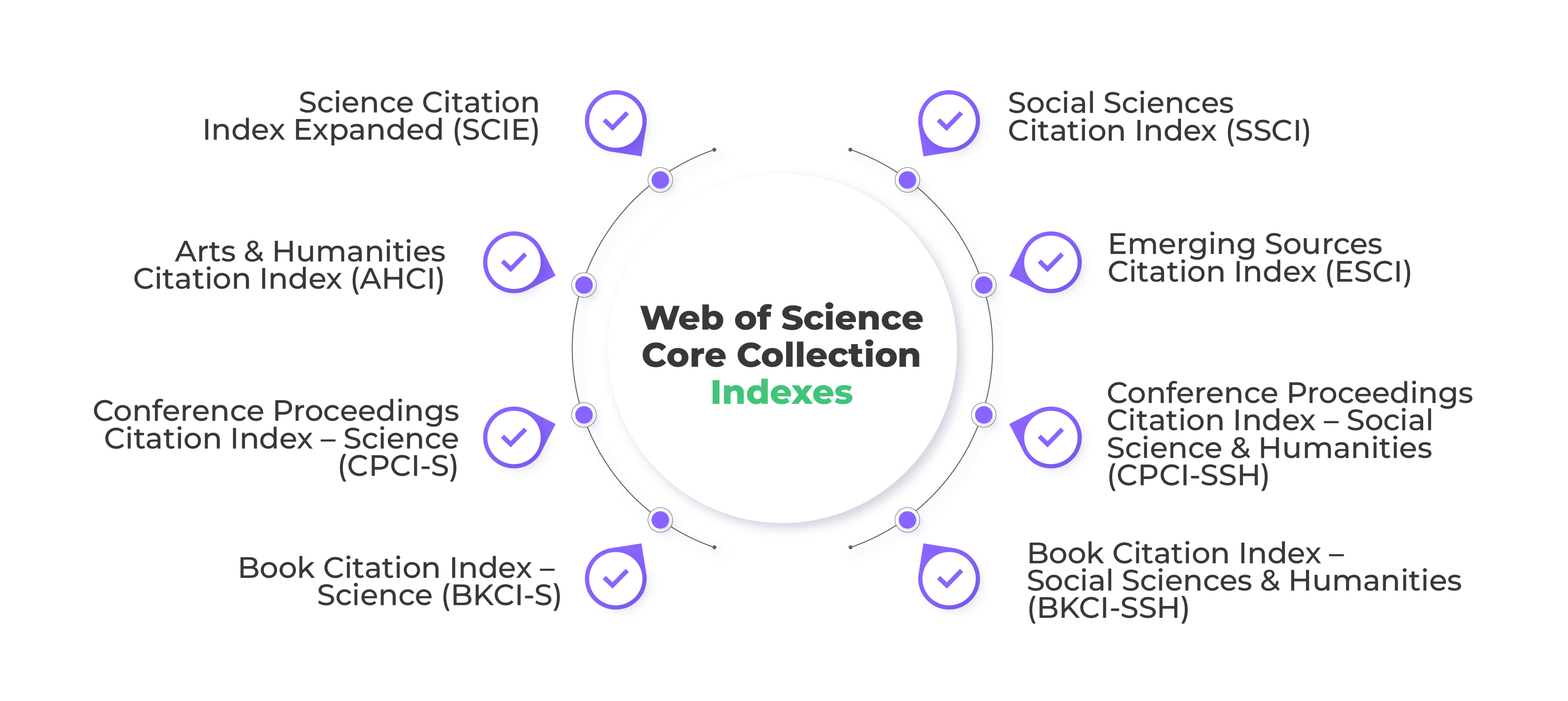
- Science Citation Index Expanded (SCIE) – an expanded citation index covering more than 9,000 academic journals across 178 subject areas.
- Social Sciences Citation Index (SSCI) – a citation index for the social sciences that includes more than 3,500 publications across 58 disciplines.
- Arts & Humanities Citation Index (AHCI) – a citation index in the field of arts and humanities, which includes more than 1,800 publications across 28 subject areas.
- Emerging Sources Citation Index (ESCI) – an index of emerging sources that contains more than 9,000 publications across 254 disciplines.
- Conference Proceedings Citation Index – Science (CPCI-S) is an index covering conference proceedings in the fields of science and technology.
- Conference Proceedings Citation Index – Social Science & Humanities (CPCI-SSH) is an index that includes conference proceedings in the social sciences and humanities.
- Book Citation Index – Science (BKCI-S) – indexes academic books and book chapters in the fields of natural and technical sciences.
- Book Citation Index – Social Sciences & Humanities (BKCI-SSH) – covers books and book chapters in the social sciences and humanities.
SCIE, SSCI and AHCI are considered some of the most important indexes, in particular because quartiles and the impact factor are calculated for SCIE and SSCI.
Regional databases of Web of Science
- Chinese Science Citation Database – a Chinese database that indexes more than 1,300 journals from 1989 onwards.
- Scientific Electronic Library Online (SciELO Citation Index) – an open electronic library covering research published in Latin America, Spain, Portugal, the Caribbean region and South Africa. The database includes more than 1,500 journals indexed from 2002 onwards.
- KCI Korean Journal Database – a database of South Korean academic journals that includes more than 2,500 publications dating back to 1980.
- ARCI Arabic Citation Index – an Arabic citation index created by Clarivate with the financial support of the Egyptian government. It includes around 586 Arabic journals indexed from 2015 onwards.
Subject-specific databases of Web of Science
- BIOSIS Citation Index. It covers more than 5,000 journals, as well as books and patents in the field of biological and medical research, dating back to 1926.
- CABI: CAB Abstracts. One of the largest bibliographic databases, indexing literature in the field of research and development from 1910 onwards.
- Current Contents Connect. A multidisciplinary database that provides access to contents, abstracts and bibliographic information from recent issues of academic journals, dating back to 1998.
- Data Citation Index. It covers research data in the natural sciences, social sciences and humanities and links them to publications in Web of Science.
- Derwent Innovations Index. It provides an opportunity for rapid searching of patents and invention citations in the fields of chemistry, electrical engineering and mechanical engineering.
- Grants Index. It contains more than 5.2 million records of awarded grants from more than 400 funding agencies in more than 15 countries.
- MEDLINE. It was created by the US National Library of Medicine and covers biomedicine, life sciences, bioengineering, healthcare, clinical practice, as well as crop production and animal husbandry.
- Policy Citation Index. It contains policy reports, as well as academic publications that were used in the development of public policy.
- Preprint Citation Index. It covers metadata of academic articles prior to their official publication in the fields of life sciences, mathematics, computer science, engineering, social sciences and humanities.
- ProQuest Dissertations & Theses Citation Index. The largest collection of dissertations and theses in the world across various disciplines, containing more than 5.5 million records.
- Research Commons. It contains additional data from academic journals sourced from open resources, which improves and optimises search on the Web of Science platform.
Tools of the Web of Science database
| Journal Citation Reports (JCR) | A tool for analysing scientific publications, which can be used to view key publication indicators, such as Impact Factor (IF), quartile and other metrics, as well as to compare journals with each other. |
| EndNote | An online service for working with bibliographic data that simplifies the search for scientific sources and the formatting of citations. |
| Publons | A platform for authors, reviewers, and editors that allows them to present their scientific achievements and create research CVs. |
| Web of Science My Research Assistant | A mobile application providing access to Web of Science tools. |
| InCites | An online platform with scientometric analysis capabilities that helps evaluate the scientific activity of institutions, researchers, and countries based on data from the Web of Science Core Collection. |
What functions does Web of Science perform?
Web of Science is a highly effective platform for searching academic sources and preparing research. It performs a number of important functions, among which the following may be highlighted:
1. Search for academic literature
The platform covers a large number of academic materials, including articles, books, conference proceedings, patents and other sources. Searches can be carried out using various filters, including year of publication, author, keywords, subject area, document type, etc., which makes it possible to quickly find relevant and high-quality academic materials.
2. Information on journal scientometrics indicators
The database contains information on such indicators as impact factor, quartile and other metrics that make it possible to assess the level of influence and prestige of an academic journal.
3. Citation analysis
Web of Science provides information on the citation level of academic publications. This helps to track which topics are the most relevant, as well as to determine which studies are in greatest demand in the academic environment.
4. Access to specialised databases
Web of Science includes collections such as SCIE, SSCI, AHCI and others, as well as databases of conference proceedings and patents. Owing to this, the platform significantly expands the range of academic materials available for searching and analysis.
What are the advantages of publishing in Web of Science for researchers?
Although the path to indexing in Web of Science is rather lengthy and involves undergoing a strict selection process, publication in a journal included in this database provides the author with a number of significant advantages.
- A rigorous peer-review process. Before being included in WoS, journals undergo a comprehensive review and careful selection. The quality of the editorial board’s work and peer review, the standard of the published materials, their compliance with the journal’s subject scope, the regularity of issues and other criteria are assessed. It is precisely because of this approach that Web of Science indexes primarily high-quality research, which increases trust both in the articles themselves and in their authors.
- Authority and recognition. Publication in a prestigious Web of Science journal, especially if it has a high Impact Factor (IF) or belongs to Q1, significantly strengthens a researcher’s reputation in the academic community. This demonstrates his or her professional competence, as well as the ability to produce high-quality, relevant and original research.
- International visibility. Owing to the broad audience, which includes researchers, universities and academic institutions, publications in Web of Science have a greater chance of being noticed and cited. This, in turn, has a positive effect on the author’s scientometrics indicators, in particular on the h-index.
- Long-term impact. After indexing, articles remain available to the academic community and for further citation over a long period of time. This allows a researcher to preserve and strengthen his or her academic influence in the long term.
Would you like to publish an article in Web of Science? Contact the company Scientific Publications. Our specialists will support you at every stage of the process, from selecting a journal to the moment of indexing. To receive a free consultation, fill in the form below, and our manager will contact you shortly. Together towards academic achievements!